
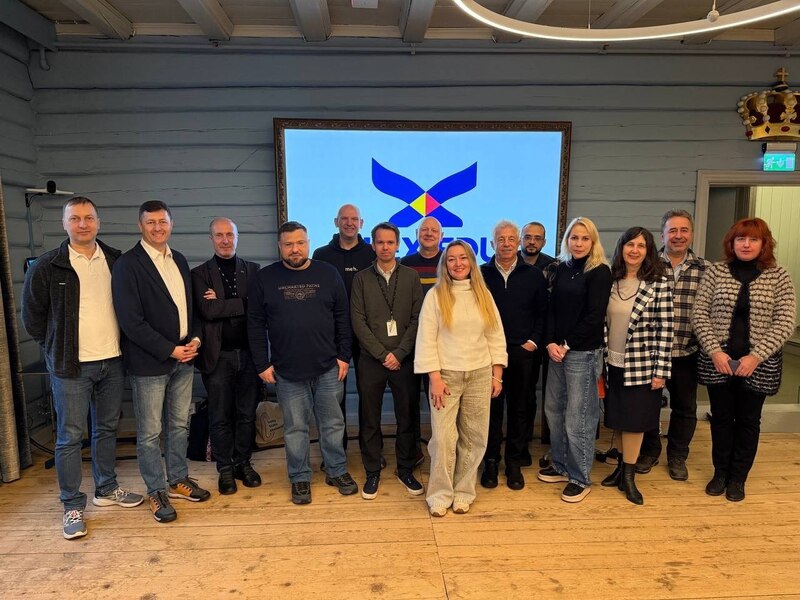
From 13 to 16 October 2026, the first in-person working meeting of representatives of the international educational project FLEX-EDU UA–NO, “Flexible, Resilient and Personalised Higher Education Systems for Crisis and Post-Crisis Contexts” (Nansen EDU-2025/10115), took place at the Kongsberg campus of the University of South-Eastern Norway (USN).
N. Karazin Kharkiv National University was represented at the meeting by project team members Nataliia Briukhanova, Head of the Department of Pedagogy, Methodology and Education Management; Iryna Synelnyk, Associate Professor of the Department of Pedagogy, Methodology and Education Management; and Yuliia Oliinyk, Associate Professor of the Department of Electrical Engineering and Electric Power Engineering at the Educational and Scientific Institute “Ukrainian Engineering and Pedagogical Academy” of V. N. Karazin Kharkiv National University. Oleksandr Kupriianov, the project coordinator at Karazin University, joined discussions of key issues online.
The event marked an important stage in developing practical cooperation between Norwegian and Ukrainian universities to modernise engineering education, introduce advanced remote laboratory technologies, and ensure access to high-quality learning during martial law and Ukraine’s post-war recovery.
International Cooperation to Modernise Engineering Education
The FLEX-EDU UA–NO project is supported by the Norwegian Nansen EDU programme and brings together five higher education institutions. The University of South-Eastern Norway coordinates the project. Its Ukrainian partners are V. N. Karazin Kharkiv National University, Sumy State University, Kremenchuk Mykhailo Ostrohradskyi National University, and Odesa Polytechnic National University.
The project’s main goal is to develop and implement a flexible learning environment for engineering education that combines traditional laboratory classes, remote access to real experimental equipment, and the use of personal laboratory kits.
Particular attention is being paid to modernising eight courses at Ukrainian universities, adapting laboratory practicals to a hybrid format, and enabling students to complete practical assignments regardless of their location.
The first face-to-face meeting in Kongsberg followed the consortium’s kick-off online session in September 2026. While the earlier stage focused on establishing a common organisational approach and allocating responsibilities, the October meeting addressed specific technical, methodological, and managerial aspects of project implementation.
Day One: Project Management and Introduction to Remote Laboratories
On 13 October, the working programme focused on partner coordination, financial management, reporting, and equipment procurement.
USN representatives presented the project’s management structure, approaches to monitoring planned activities, coordination between work packages, and preparation of reporting documents. Particular attention was given to financing procedures, documentary evidence of expenditure, and procurement requirements under the Nansen EDU programme and national legislation.
An important part of the first day was an introduction to the remote laboratory technology ecosystem at the University of South-Eastern Norway.
Norwegian specialists presented the architecture of the laboratory systems, their operating principles, and ways to provide access to experimental equipment through a web browser. The programme included a demonstration of technologies that allow students to interact remotely with real laboratory setups, take measurements, and analyse experimental results.
Such solutions are particularly important for Ukrainian universities, where continuity of education may depend on the security situation, stability of electricity supply, and availability of educational infrastructure.
Day Two: Pocket Lab Technologies and Laboratory Infrastructure Preparation
On 14 October, the main focus was on technical solutions for establishing hybrid and remote laboratories, particularly the Pocket Lab concept of compact personal laboratory kits.
The programme included presentations by Ukrainian partners on the current state of their laboratory equipment, existing technical capabilities, and infrastructure modernisation needs. Each university presented materials relating to the courses to be adapted within the project.
USN specialists introduced participants to Pocket Lab architecture, Arduino-based kits, and the organisation of measurement data acquisition and processing. These technologies enable practical assignments to be carried out outside conventional university laboratories. Students can work with compact equipment, generate experimental data, and develop skills in programming, measurement, and investigation of technical systems.
The practical session included group work on developing equipment specifications for partner universities. Discussions covered component compatibility, laboratory system reliability, electrical safety requirements, and the suitability of equipment for educational tasks.
The outcomes of these discussions are expected to provide a basis for further refinement of the equipment lists and planning of laboratory infrastructure modernisation.
Day Three: Curriculum Adaptation and Integration of Digital Technologies
On 15 October, participants focused on methodological aspects of introducing new laboratory technologies into teaching and learning.
A central topic was aligning the content of the eight courses involved in the project with the capabilities of remote and personal laboratories. Methodological discussions explored approaches to reviewing existing course components, identifying laboratory activities suitable for hybrid delivery, and designing scenarios for remote experiments.
Considerable attention was given to integrating laboratory systems with digital learning platforms—Learning Management Systems (LMS). Such integration should not only provide students with access to laboratory assignments, but also enable structured learning support, monitoring of completed work, collection of results, and analysis of educational achievement.
Subject-specific working groups were scheduled to discuss practical options for modernising courses in light of their disciplinary requirements. University representatives prepared preliminary conclusions on adapting course content and identifying necessary changes to laboratory practicals.
Day Four: Implementation Planning, Quality Assurance, and Competence Assessment
The final working day, 16 October, was devoted to consolidating the work undertaken and planning the next stages of the project.
Ukrainian partners presented preliminary plans for adapting and implementing laboratory infrastructure. Working sessions addressed the sequence of laboratory space preparation, equipment procurement and installation, configuration of technical systems, and procedures for verifying their readiness for educational use.
A separate session focused on developing a methodology for assessing students’ competencies. The effectiveness of educational modernisation is expected to be assessed not only by the introduction of new technologies, but also by students’ learning outcomes. This requires common approaches to defining competence indicators, measuring them, and comparing results before and after the introduction of modernised laboratory courses.
Key elements of the future assessment system should include experimental skills, the ability to work with measurement equipment, analyse data, solve engineering problems, and organise practical activities independently. The programme also included discussions of quality assurance requirements, technical validation of laboratory solutions, and safe equipment operation.
The concluding part of the meeting focused on coordinating the partner universities’ next steps, assigning responsibilities, and setting deadlines for priority tasks. In particular, the programme envisaged action plans for the period up to 1 November and through the end of December 2026.
The FLEX-EDU UA–NO project demonstrates the practical value of international academic cooperation for the development of engineering education in Ukraine, combining Norwegian experience in implementing remote laboratories with the needs of Ukrainian higher education institutions.


