
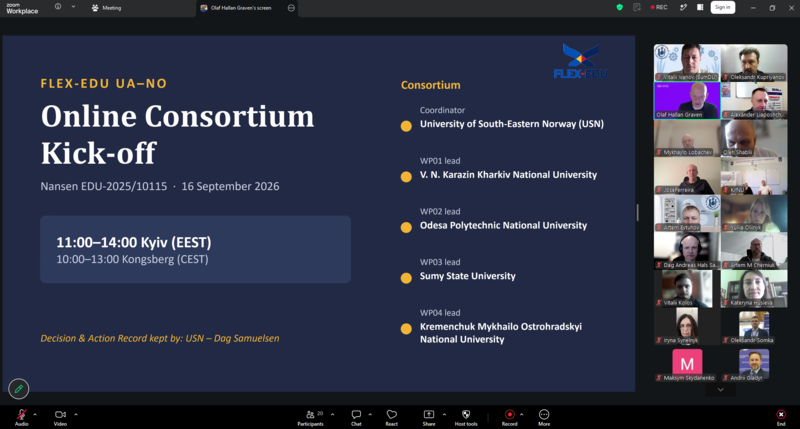
On 16 September 2026, the partners of the international FLEX-EDU UA–NO project held their first joint online meeting — the Consortium Kick-off. Participants discussed progress during the initial phase of the project, current tasks and preparations for the forthcoming in-person meeting in Norway.
The meeting opened with a welcome address and a presentation on the organisation of the consortium’s work by the project coordinator, Professor Olaf Hallan Graven of the University of South-Eastern Norway. Representatives of all Ukrainian universities participating in FLEX-EDU UA–NO joined the discussion. The first project work package, WP01 “Capacity Building & Infrastructure”, is led by V. N. Karazin Kharkiv National University. During the meeting, Professor Oleksandr Kupriyanov, Deputy Director of the Educational and Scientific Institute “Ukrainian Engineering and Pedagogical Academy” and the project coordinator at Karazin University, presented a detailed report on the work completed and the current implementation status of WP01. Reports were also delivered by the leads from the partner universities: Professor Oleh Shablii (Odesa Polytechnic National University), Professor Vitalii Ivanov (Sumy State University) and Professor Andrii Hladyr (Kremenchuk Mykhailo Ostrohradskyi National University).
Participants paid particular attention to preparations for the consortium’s in-person meeting in Kongsberg, Norway, scheduled for 12–17 October 2026. This meeting will provide an opportunity for the partners to move from agreeing on common approaches to detailed planning of the project’s practical implementation. The working materials also identified the main areas for the next stage of joint work: developing digital and laboratory infrastructure, preparing educational solutions and establishing mechanisms for their subsequent implementation. The first kick-off meeting marked an important step in cooperation between the Ukrainian and Norwegian partners. The next stage will involve intensive development, piloting and implementation of flexible engineering education models capable of operating even in times of crisis and with limited access to traditional educational infrastructure.


